

When AI Designs Experiments Humans Can't Explain_
There's a quiet crisis brewing in physics labs, and it has nothing to do with broken equipment or funding cuts.

When AI Designs Experiments Humans Can't Explain_
There's a quiet crisis brewing in physics labs, and it has nothing to do with broken equipment or funding cuts. It's about understanding — or rather, the lack of it.
An AI system recently proposed an improved design for gravitational-wave detectors, the kilometer-scale instruments that first captured ripples in spacetime back in 2015. The design appears to work better than what human physicists came up with. The problem? Nobody can fully explain why. Researchers have spent months trying to reverse-engineer the AI's reasoning, peeling back layers of a solution that emerged from optimization algorithms rather than physical intuition.
This isn't a one-off curiosity. It's part of a growing pattern where AI systems are moving beyond data analysis into experimental design itself — proposing setups that outperform human baselines but resist human comprehension. And it's forcing the scientific community to confront an uncomfortable question: if a machine finds something that works but nobody understands it, is that still science?
From Data Cruncher to Experiment Designer
For years, AI's role in physics was relatively straightforward: crunch numbers, classify signals, fit models. Machine learning helped LIGO sift through noise to find gravitational-wave signals. Neural networks classified galaxy morphologies. These were tools that amplified human capability along axes humans already understood.
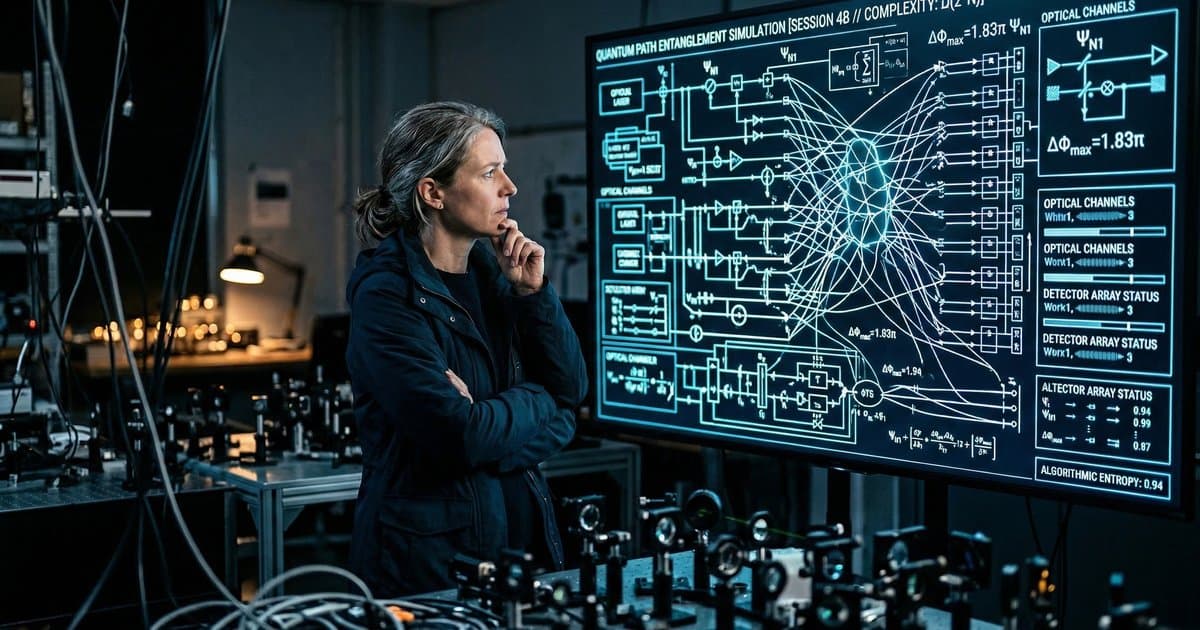
The newer generation of AI-for-science work is different. Instead of analyzing the output of experiments, AI is now designing the experiments themselves. The pioneering example came from quantum optics. In 2016, Mario Krenn and collaborators introduced an automated search system — known as "Melvin" — that could propose entirely new optical table setups for generating complex entangled quantum states (Krenn et al., Physical Review Letters, 2016). Melvin didn't just optimize parameters within a known design — it assembled novel configurations of beam splitters, crystals, and detectors that experienced experimentalists hadn't considered.
What made this genuinely startling was that some of Melvin's proposals were non-intuitive even to experts. Seasoned quantum opticians would look at a machine-generated layout and struggle to articulate the physical principle behind it. The designs worked in simulation, and some were subsequently verified in the lab, but they didn't map neatly onto the conceptual building blocks physicists normally use to reason about light and entanglement.
As Erhard et al. documented in their review of high-dimensional entanglement (Nature Reviews Physics, 2020), the experimental design space for complex photonic setups has grown so large — so many optical elements, so many degrees of freedom in phases, transmissivities, and detection schemes — that computer-aided discovery isn't just helpful, it's arguably necessary.
Gravitational Waves and the Stakes of Opacity
Now this approach has reached gravitational-wave detection, and the stakes are considerably higher.
LIGO's observatories each use 4-kilometer arms in a Michelson-type laser interferometer with Fabry-Pérot arm cavities. Upgrades to these instruments are expensive, slow, and safety-critical. You don't casually reconfigure a billion-dollar detector because an algorithm said so. Every design choice needs to be understood, debugged, maintained, and defended before an international collaboration of hundreds of physicists.
A 2025 preprint by Arlt et al. (arXiv:2510.10707) reports that AI-driven optimization found an interferometer design that improves upon human-designed baselines for gravitational-wave detection sensitivity. The approach treats detector design as a search problem over a compositional space: optical elements (mirrors, squeezers, cavities, phase shifters) and their interconnections form a kind of graph, with an objective function capturing strain sensitivity, quantum noise performance, and trade-offs with thermal noise and optical losses.
The resulting design, however, is not something a physicist would have drawn on a whiteboard. The coupling between squeezing angles, homodyne detection angles, cavity detunings, and loss parameters creates an optimum that depends on non-local interference effects across multiple subsystems simultaneously. Performance emerges from the collective interaction of many components, not from a clean modular principle you can explain in a paragraph.
Note: The Arlt et al. result is a preprint — not yet peer-reviewed, and certainly not a hardware deployment. It crystallizes the tension perfectly: the AI found something promising, and the humans are still working to figure out what it means.
Why AI Solutions Resist Explanation
To understand why machine-generated experimental designs are opaque, it helps to think about how these systems actually work. The typical pipeline formalizes experiment design as a search over a compositional graph with three elements:
- Building blocks — the optical components (beam splitters, mirrors, nonlinear crystals, squeezers, detectors), each with tunable parameters
- Connections — how light paths are routed between components
- Objective function — a scalar score; for gravitational-wave detectors, this might weight quantum noise reduction, broadband sensitivity, and robustness to realistic losses
The search itself can take several forms — evolutionary algorithms, reinforcement learning, or differentiable optimization — and any of them can find solutions that are hard for humans to parse, for several compounding reasons:
Non-local interactions. Performance depends on interference patterns across many paths and modes. Humans naturally reason in modular, local terms — "this cavity does X, that squeezer does Y" — but the AI's solution may only work because of subtle phase relationships spanning the entire layout.
High-dimensional parameter coupling. Squeezing angle, homodyne angle, and cavity detuning are all entangled in ways that defy one-variable-at-a-time reasoning. You can't understand the design by tweaking one knob and seeing what happens, because the knobs are correlated.
Overcomplete designs. The AI has no aesthetic preference for minimalism. It may produce something that works via three interacting mechanisms when one sufficiently clever mechanism would suffice — but finding that simpler equivalent is itself a hard problem.
Metric gaming. The optimization might be exploiting quirks or approximations in the simulator rather than discovering genuine physical improvements. This is a major reason why verification isn't optional.
The Interpretability Counterattack
The research community isn't simply shrugging at the opacity problem. A growing body of work treats interpretability as a first-class engineering challenge, not a philosophical afterthought.
Ruiz-Gonzalez et al. (Quantum, 2023) and a follow-up preprint (arXiv:2511.19364, 2025) have developed approaches for making machine-designed experiments more comprehensible. The general strategy involves several complementary techniques:
Simplification through pruning. Systematically remove components from the AI's design while monitoring whether performance degrades. If you can strip away half the elements and still hit the target metric, you've identified what's essential and what's scaffolding.
Motif detection. Search for repeating subgraphs that correspond to known physical operations — interferometric identities, teleportation-like circuits, standard squeezing configurations. If you can decompose the AI's complex graph into familiar building blocks arranged in an unfamiliar way, you've gained a foothold for understanding.
Symbolic distillation. Compress the discovered design into a smaller equivalent circuit or an analytic transformation. This is the holy grail — turning the AI's implicit knowledge into an explicit design principle that fits in a textbook.
Robustness stress-testing. Vary losses, parameter drift, and control imperfections to see whether the design is a brittle knife-edge optimum or embodies a stable physical principle.
Warning: For gravitational-wave detector proposals specifically, robustness stress-testing is non-negotiable. A design that collapses under realistic perturbations isn't just hard to understand — it's probably not worth building.
Wang et al. (Physical Review Letters, 2024) provide additional context for how AI-optimized photonic designs interact with physical verification, further demonstrating that the loop from machine proposal to experimental validation is tightening — but still requires significant human effort at the verification stage.
Trust, Verification, and a New Workflow
The debate around AI-designed experiments maps onto a broader tension that software developers will recognize: automation versus auditability.
On one side, there's a pragmatic argument. If a design is experimentally verifiable and robust under perturbation, it's valuable even if the intuition comes later. Physics has a long history of "shut up and calculate" — using formalisms that work before fully understanding why. Quantum mechanics itself was applied for decades before the interpretive questions were (partially) settled.
On the other side, there's a legitimate engineering concern. If no one can explain why a design works, no one can predict when or why it will fail — especially under conditions the simulator didn't model. For instruments where downtime costs millions and commissioning takes years, that's not an acceptable risk posture. Interpretability isn't philosophy; it's maintainability, debugging, and safety review.
There's also the simulator bias problem. AI optimizers are only as good as the simulation they optimize against. If the model omits a noise source, uses an idealized loss budget, or approximates a nonlinear effect, the AI may find a "solution" that exploits the gap. Multi-fidelity simulation, uncertainty quantification, and cross-checking with independent modeling tools — the gravitational-wave community uses tools like FINESSE and GWINC — become essential sanity checks.
A pragmatic workflow is emerging from this tension:
- Use AI as a proposal generator that explores the design space far more aggressively than any human team could
- Apply interpretability algorithms to simplify and explain the top candidates
- Subject survivors to rigorous verification against independent simulations and, where possible, scaled-down experimental tests
- Only designs that pass all three stages — performance, interpretability, and verification — advance toward real hardware
This isn't so different from how we're learning to work with AI-generated code: let the machine draft, then review, test, and understand before shipping.
What Comes Next
We're at an inflection point. AI systems are transitioning from tools that help scientists do what they were already doing to agents that propose things scientists hadn't considered. The gravitational-wave detector work is a flagship example, but the pattern extends to quantum optics, materials science, drug design, and beyond.
The key insight from this line of research isn't that AI is smarter than physicists. It's that search algorithms and human intuition have complementary blind spots. Humans reason modularly and seek minimal explanations. Machines explore high-dimensional spaces without aesthetic bias. The most powerful approach combines both: let machines find, then let humans understand.
The uncomfortable part — the part that makes this a genuine intellectual challenge rather than a marketing story — is that understanding isn't guaranteed. Some AI-generated designs may resist simplification. Some optima in high-dimensional parameter spaces may be genuinely non-decomposable, irreducible to the kind of one-sentence explanation physicists crave.
If that turns out to be the case, the scientific community will need to develop new standards for what counts as sufficient understanding. Not the old standard of "I can explain it on a blackboard," but perhaps a new standard of "I can verify it under all plausible conditions and bound its failure modes." That's a profound shift — and one that the gravitational-wave community, with its culture of extreme rigor, is well-positioned to navigate.
The ripple from that detector design may travel further than anyone expects.
Related Posts_

The AI Gap Nobody Talks About: You've Seen the Demo, Now What?
You've had the moment. You're watching a demo, or you've just typed something into ChatGPT on a whim, and the response comes back and you think — okay, that's genuinely remarkable.

AI Personality Is a Feature, a Bug, and a Mirror
If you've ever felt like ChatGPT was being weirdly cheerful, or noticed that Claude has a different vibe than Gemini, you're not imagining things.
Mercury Two Rewrites the Rules on Inference Speed
There's a question that comes up a lot in production AI discussions that almost never gets asked in benchmark threads: what does it actually feel…